Dolcetto d’Alba DOC
Dolcetto is the most typical wine of the Langhe.
Well beyond the postwar period, it was the undisputed ruler of the hills on the right of the Tanaro, widespread in the areas around Alba and also in Alta Langa. It was—and in some ways still is—the wine of tradition, the one experienced and “drunk” daily, with great pleasure and satisfaction.
Anyone who had a few rows around Alba planted dolcetto. Thanks to early ripening and low acidity, it was used as a meal grape and wine to show off on any occasion.
Less rare than Barolo, less ceremonious than Barbaresco, easier than Nebbiolo, Dolcetto suited the rustic life of the time, and that rusticity, in some ways, is the note that still makes it different today.
We must not make the mistake, however, of considering it a “simpleton.” Dolcetto is a demanding grape variety and its namesake wine a small masterpiece of balance between tannin and fruit, between pleasantness and affability.
This is how, after obtaining DOC status in 1974, Dolcetto d’Alba has continued to reap a fair amount of success, especially in its more complex and “intelligent” versions, in which it is not downgraded to the rank of “table wine” but treated with the respect it deserves: a great wine worthy of representing the Langhe in its most authentic and drinkable form.
Vines
Appellation
Color
Type
Min. alcohol
Variants
Established on
The history of Dolcetto d’Alba DOC
The wine of the daily table
The first historical news regarding the dolcetto grape variety comes from the archives of the Municipality of Dogliani.
Here, in the record of a session dated August 28, 1593, it is established that: "No one shall dare to harvest grapes before the feast of St. Matthew, and if anyone, out of necessity or other consideration, wishes to harvest some Dozzetti or other grapes, he shall be required to obtain permission from the deputy... under penalty of forfeiture of the grapes." This is the first documentable appearance of Dozzetto, or Dolcetto, indicating that the grape variety was popular in the Langhe area and held in such high regard that its harvest needed to be regulated.
The etymology takes us back to the original meaning of the term which, contrary to how it sounds in Italian, refers to the dialectal duset or dosset, meaning "small hill ridge" (although there are those who still embrace the idea that the word indicates the sweetness of the grapes when tasted).
Some scholars, however, hypothesize a different origin. Citing as evidence one of Dolcetto's synonyms, namely "Ormeasco," they maintain that the grape variety was imported to Italy by the Saracens and cultivated starting in the 14th century precisely in Ormea, a municipality straddling Liguria and Piedmont, by decree of the Marquises of Clavesana.
For other news of dolcetto, we must jump to 1839. Giorgio Gallesio, author of Pomona italiana, qualifies it as Vitis Aquaestatellaensis, from the Roman name of Acqui Terme, writing that: "Everything suggests that it was born in Monferrato" and that its cultivation and spread began around the year 1000, with the repopulation of the hilly area extending "from Mondoví to Novi."
"Doglianese," "ormeasco," or "acquese," the fact remains that dolcetto rows developed especially on the hills of the Langhe, from which they likely spread subsequently to Monferrato. In the Alba area it became so popular that it surpassed Barolo and Barbaresco in fame, at least until the postwar period.
It was certainly the most cultivated grape variety, the wine of the daily table, the one to which families were most attached. It spread widely in Alta Langa only to be progressively abandoned. Not only because of the difficulty of cultivation, but also because it lacked any protective law defending the name and quality. A void partially filled by obtaining DOC status in 1974, which had the merit of distinguishing the Dolcetto of the Alba area from that of Diano, Ormea, Acqui Terme, or Ovada.
Today the fate of Dolcetto d'Alba is uncertain. On one hand, the rows are being uprooted in favor of nebbiolo, whose fame is eroding much of the space dedicated to the native grape varieties of the Langhe. On the other, some producers are investing in the quality of the denomination, helping to enhance its unique characteristics: that vinous fragrance with an accentuated, pleasant bitter undertone that make it an easy-drinking wine, anything but banal.
Dolcetto d’Alba DOC: Terroir
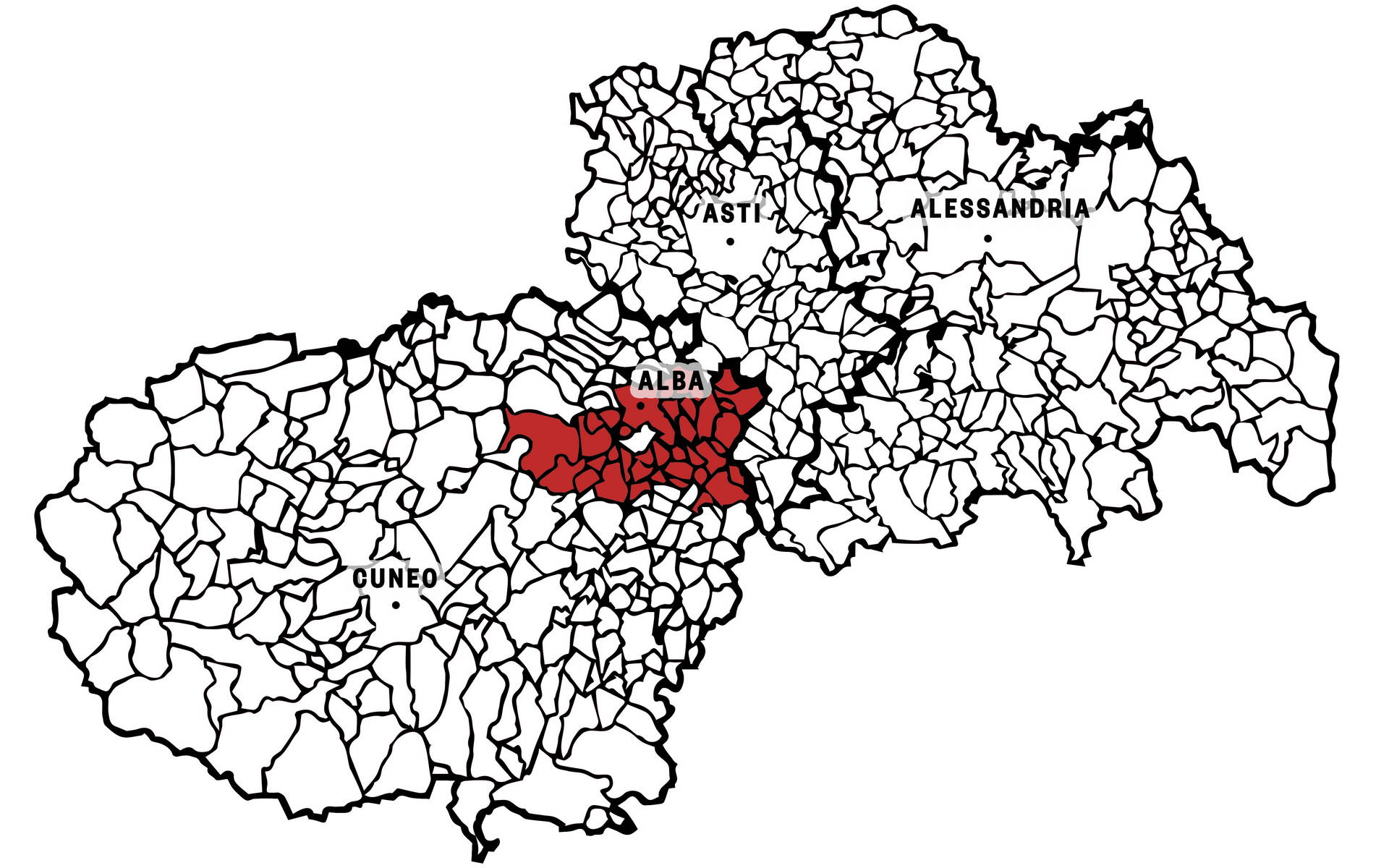
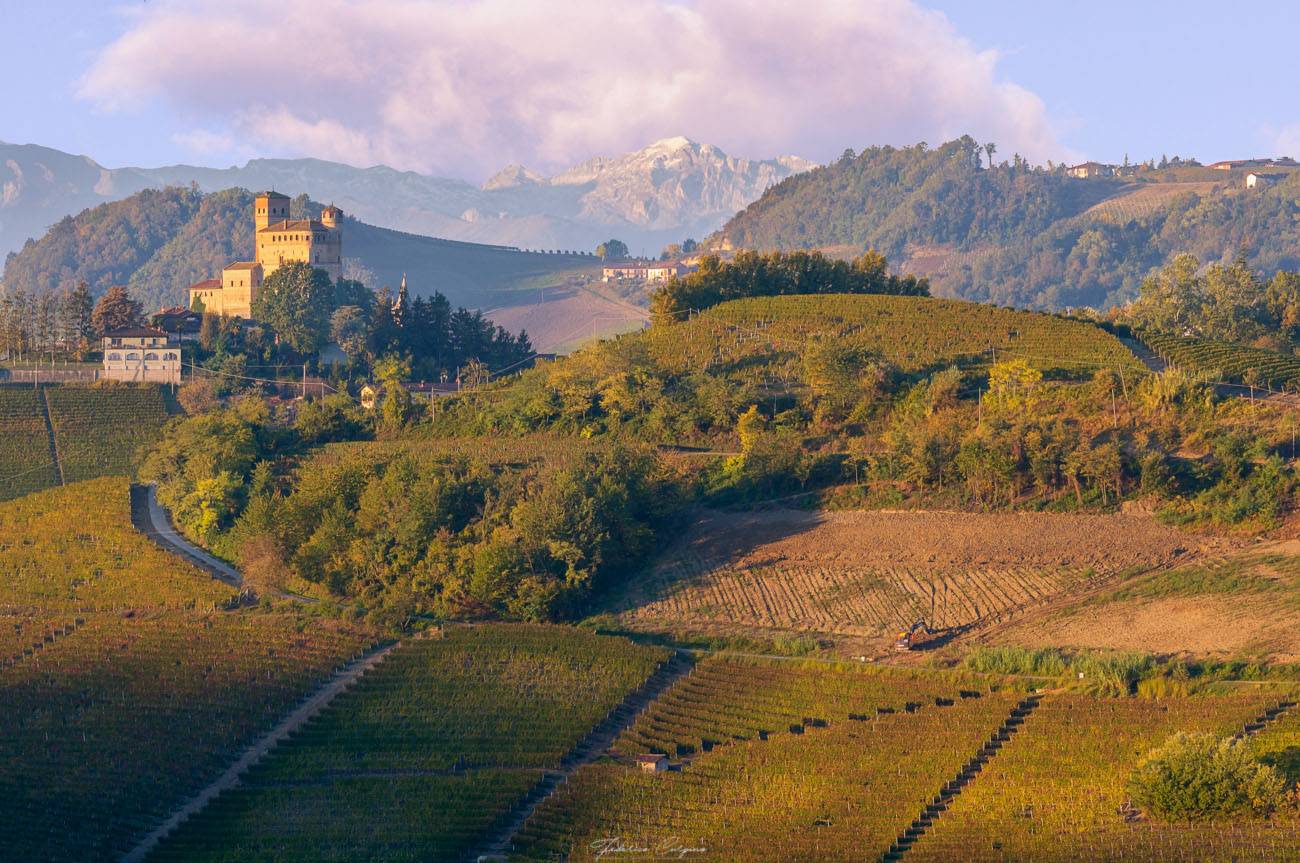
The Dolcetto d'Alba denomination extends over the hills of 35 municipalities distributed in a radial pattern around the city of Alba, in the Langhe.
Roughly speaking, the area extends from Narzole to Santo Stefano Belbo on the West-East axis; and from Neive to Cortemilia on the North-South axis.
The vineyard hills are almost all located on the right bank of the Tanaro river and rest on soils of Miocene origin, dating back almost 70 million years.
From a geological point of view, the soils of Dolcetto d’Alba can be divided into two areas.
The first is the eastern one, enclosed between the hills of Barolo and Barbaresco: characterized by gray-bluish clay marls, it produces more dense and structured wines.
The second proceeds in the direction of Valle Belbo. It features more loose, calcareous and sandy soils that translate into more fragrant, fine and light wines.
Preferred Altitude
Preferred Soil
Crus / MGA
Towns where it's produced


Dolcetto d’Alba DOC: Vines
The Dolcetto d’Alba DOC is a single varietal wine, and therefore can be made exclusively by Dolcetto grapes
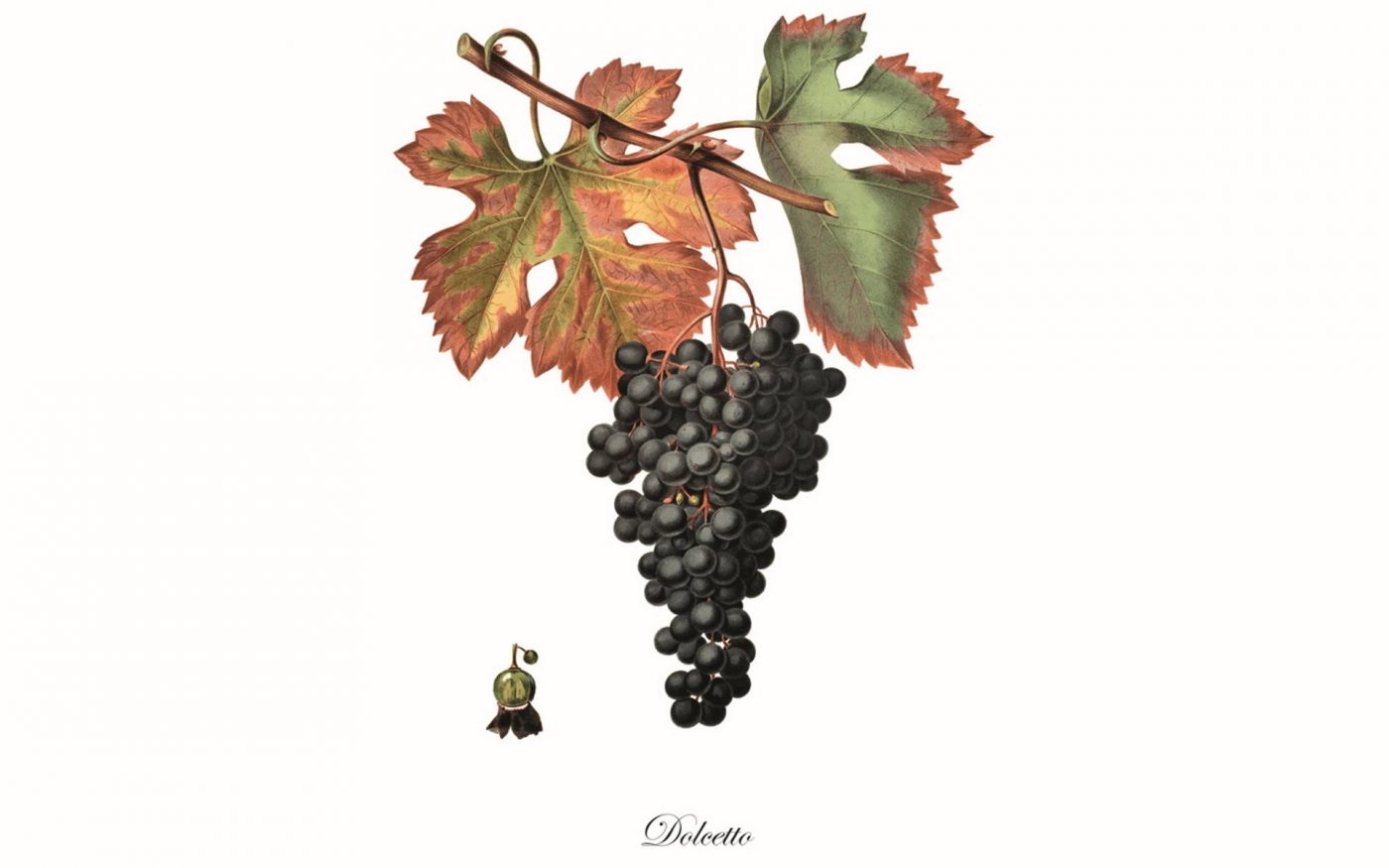
The bunch of Dolcetto is a long pyramid in shape, and the grapes are round, with a blue-black skin. The fruit ripens in mid September. you can read more about Dolcetto here.

Dolcetto d’Alba DOC: Features
Harmonious wine, properly tannic, with a slight almond taste that makes it perfect for the entire meal.
Dolcetto is truly the wine that can be brought to the table on any occasion thanks to its characteristic flavor, not too alcoholic, capable of pairing with practically any dish.
The Superiore version, while maintaining incredible drinkability, deepens the "blue" notes of this grape variety.
The red fruit becomes more full-bodied and shifts toward jam and dark-skinned berries, enveloping the mouth with a delicate tannic note (which becomes sweet and soft if aged in wood) and a hint of spices.
Sight
Dolcetto d'Alba presents a beautiful deep red color, intense and impenetrable to light, with some violet hues.
Nose
In the more immediate and young versions, fruity notes prevail.
The Superiore version takes on hints of fruit in spirits, cherry, almond and ink.
Taste
The typical note of Dolcetto d'Alba is the almond aftertaste and the right sensation of astringency given by the tannins, which cleanse the palate and invite another sip.
If the young version of Dolcetto d'Alba is all about fruit (plum, currant, blueberry, blackberry), the Superiore becomes more elegant and austere, deepening the nuances sometimes spicy, sometimes delicately mineral.
Official regulation
Color
Perfume
Taste
Foam
Get a bottle directly from the producer
LoveLanghe Shop is a niche of great wines from the Langhe area: some unknown to most, some already quite recognized but perhaps hard to find in the big distribution, others in which we see potential but that have yet to grow.
Bottles are shipped directly from the winery to your home, with no intermediary.


Service
Serve in large ballon glasses at a temperature of 18° - 19° C.
Dolcetto d’Alba DOC: what to pair it with
Dolcetto d'Alba is truly a wine for the entire meal.
It accompanies stuffed pasta dishes, pasta with ragù, red and white meats, medium-aged cheeses.
It reaches peaks of excellence with traditional Piedmontese dishes: polenta, bollito and bagna cauda.
But Dolcetto d'Alba does well with a simple salad, a flavorful pizza and a plate of carbonara pasta.
Recipes to pair with Dolcetto d’Alba DOC


Dolcetto d’Alba DOC: Production
Dolcetto is one of the most challenging native grape varieties of Piedmont, marked by extreme sensitivity and delicacy that manifest both in the vineyard and in the cellar.
From an agronomic point of view, it suffers from temperature fluctuations, excessive fertilization and, in general, cold and humid soils.
Particular attention must be paid to vinification, as the bunches are small and very rich in polyphenols, those natural compounds present in the skins and seeds that give the wine its organoleptic characteristics: color, aroma, taste, astringency.
The ratio between solid and liquid parts is therefore high and, especially during the maceration-fermentation phase, extreme delicacy is necessary. The risk is that of extracting too many tannins (dolcetto has on average three seeds per berry versus two for other varieties) with the consequent development of vegetal aromas, pronounced bitterness and excessive astringency.
Dolcetto grapes are usually harvested after mid-September. After crushing and destemming they are placed in stainless steel tanks, where maceration begins, accompanied by alcoholic fermentation. Many producers have adopted the technique of punch-downs and pump-overs to seek ennobling extraction.
The basic version of Dolcetto d’Alba is aged in steel and is released young, starting from the spring following the harvest.
The Superiore, on the other hand, must age for at least 12 months. The regulations do not specify the materials for aging tanks. More and more producers have thus chosen a passage in wood, a characteristic that softens the rough edges of Dolcetto and delivers a decidedly deeper and longer-lived wine.
Time in wood
Time in bottle
Time to market
Grapes Yield
Meet the producers





Curiosities
Dolcetto is a very widespread grape variety throughout southern Piedmont.
It is a truly native variety, just think that attempts have been made to plant it elsewhere but every experiment has been in vain.
Based on the location of the vineyards, the soils and the different terroirs, it produces very different wines, which have been recognized by as many denominations.
The hills around Alba produce Dolcetto d’Alba DOC, perhaps the most typical and traditional.
Those of Diano give life to Diano DOCG (or Dolcetto di Diano), which had the foresight to be divided into Sorì (or cru) and represents one of the leading expressions of the type.
There is also Dogliani DOCG, the typical Dolcetto of the western Langhe.
There are Ovada DOCG, cultivated in the surroundings of the city of the same name and aged for at least 12 months, Dolcetto d’Asti and Dolcetto d’Acqui.
Finally, there are more “extensive” and less localized versions of Dolcetto. There is Langhe DOC Dolcetto, cultivated over a vast territory between Langhe and Roero, Dolcetto dei Colli Tortonesi, Monferrato Dolcetto, Dolcetto del Pinerolese and Dolcetto d’Ovada (not to be confused with Ovada DOCG which represents its Superiore version).
To tell the truth, there was also a rare Dolcetto delle Langhe Monregalesi which, fortunately, with the 2011 regulations was merged into Dogliani DOCG, simplifying life for consumers!
News about Dolcetto d’Alba DOC

