Freisa d’Asti DOC
Often relegated to the background compared to much more famous reds, Freisa is a hidden gem among the wines of Piedmont.
A close relative of nebbiolo, this indigenous grape variety was cited by Hemingway himself, who had the chance to taste it during the Great War fought in Italy.
Thanks to a marked versatility and a first-rate tannic character, Freisa, when well-vinified, expresses a surprising muscular structure, with bold, elegant tannins and a long, persistent finish.
In addition, it is a very identifiable wine thanks to its unmistakable raspberry note.
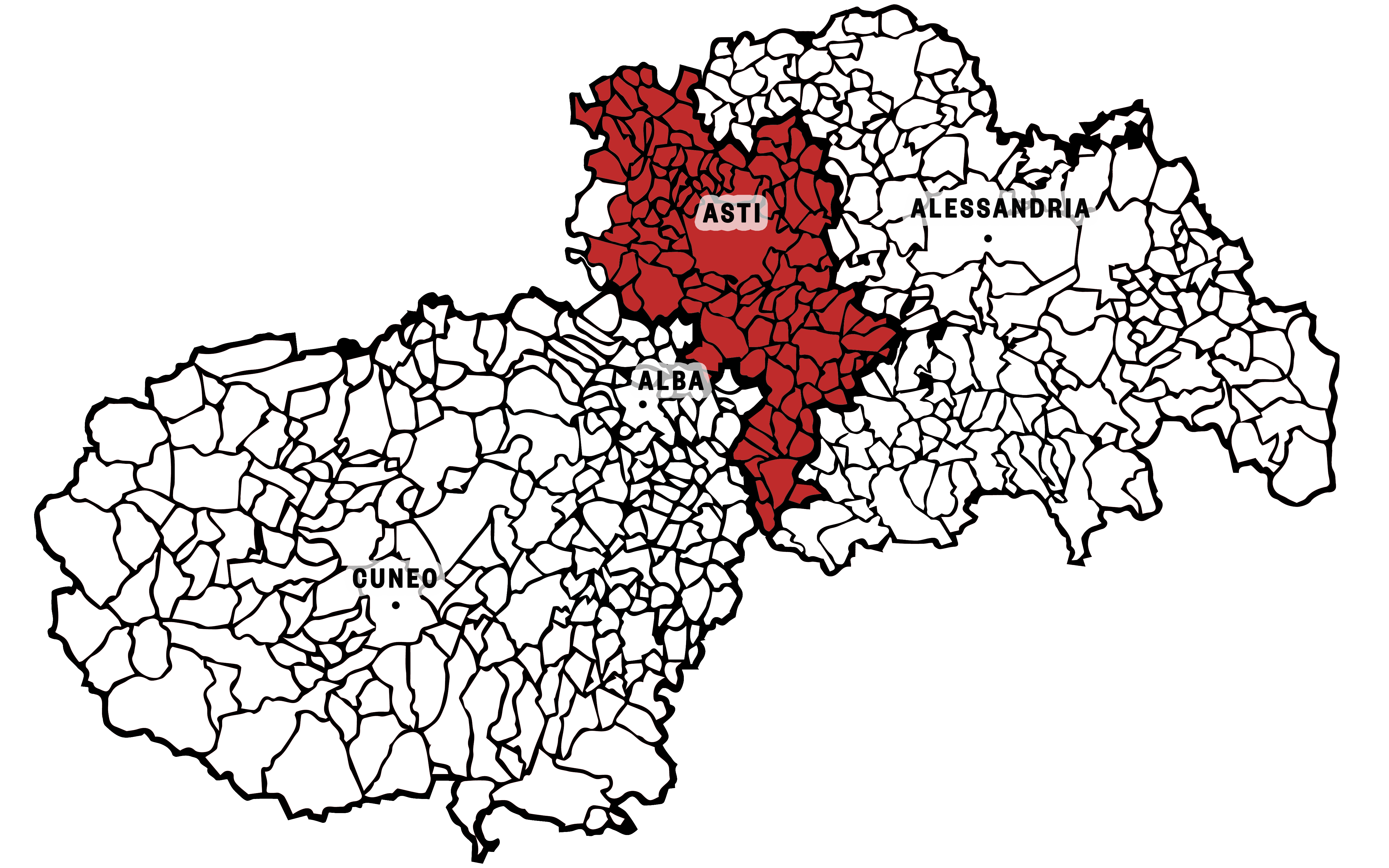
Although in this article we will mainly talk about Freisa d’Asti DOC, whose primary area is the Asti Monferrato, in Piedmont the Freisa grape also expresses itself in Langhe Freisa DOC (a fairly rare wine) and in the Chieri area, where Freisa di Chieri DOC has become an ambassador for the Turin hills.
Vines
Appellation
Color
Type
Min. alcohol
Variants
Established on
All family members contribute to the quality of the wines
The history of Freisa d’Asti DOC
From oblivion to the rebirth of Freisa
A journey through the thousand-year history of one of the hidden jewels of Piedmontese enology.
A glorious past
An indigenous Piedmontese grape variety, Freisa has a history dating back thousands of years, rooted in the Middle Ages. The earliest mentions, however, date back to the 16th century, when our wine was referred to in the customs tariffs of the time as frese. Fine wine, apparently, because it was paid twice as much as ordinary wine. Some interesting information is passed on to us by Count Giuseppe Nuvolone-Pergamo, director of the Experimental Garden of the Royal Society of Agriculture of Turin. In the 18th century, he listed Freisa among Piedmont's top-quality black grapes.
A wide spread
It was from the 1700s onward that the freisa grape variety spread throughout Piedmont, becoming one of the most cultivated and appreciated. Famous scholars of the time described it as a unique wine with unmistakable organoleptic characteristics. Its resistance to downy mildew favored its cultivation, while its versatility in blends made it the protagonist of various blends, from dry red wines to sparkling wines.
Toward the end of the 19th century, Freisa is cited as one of the most cultivated vines in the Turin area and one of the most sought-after in the capital. It was during these years that it also spread to Monferrato, especially around Asti, where it became a wine capable of being both everyday and luxury, depending on the expertise of the winemaker. Indeed, Freisa has a great capacity for ageing thanks to its impressive tannic presence. As well as a respectable aromatic range.
An undeserved oblivion
Arnaldo Strucchi (one of the fathers of Piedmontese oenology) wrote in the late 1800s that Freisa has a fair amount of commercial potential to the Americas (especially in its sparkling version). Hemingway mentions it in his Farewell to Arms, and authoritative voices praise its quality. But the grape variety is doomed to abandonment. Unproductive, susceptible to fungal diseases, erratic and erratic, it was spieced in favor of Dolcetto and Barbera, which in the postwar period quenched the "thirst" of dance halls and expanding cities. Finally, in the 1990s, the success of Nebbiolo overwhelms everything, including the "fragile" Freisa vine and its derisory productions.
A possible revival
The abandonment of Freisa cultivation was for years a stain on the carnet of Piedmont wines. A fault partly remedied by consumers, today increasingly attentive to the typicality of wines. The rediscovery of native varieties and the indefatigable work of some producers on Freisa are slowly redeeming the potential of an all-round noble wine, capable of exciting versatility and character.
Freisa d’Asti DOC: Terroir
The area of choice for Freisa extends along the ridges of the province of Asti, excluding the municipal territories of Cellarengo and Villanova d'Asti.
These are soft hills immersed among woods and cultivated fields, with little human impact, whose soils are typical of the Asti Monferrato: clay-limestone and clay-sandy terrain.
The Asti sands are precisely what constitute the peculiarity of the Freisa terroir.
Composed of sandy deposits from an ancient shallow sea, they have a texture rich in minerals and fossils, which gives the wines produced here unique characteristics: good minerality, an excellent aromatic profile, elegance, and finesse.
The mix of clay and limestone provides longevity and a dose of natural acidity that keeps the wine’s freshness alive.
Preferred Altitude
Preferred Soil
Crus / MGA
Towns where it's produced


Freisa d’Asti DOC: Vines
The Freisa d’Asti DOC is a single varietal wine, and therefore can be made exclusively by Freisa grapes
This typical piedmontese vine is particulary sturdy, thriving in clay or marl, which explains its presence in all the wine-growing provinces of Piedmont. The bunch is long, with a greeen stalk. The grapes are round or slightly oval, and bluish in colour. The plant usually produces an abundant harvest. The grapes are harvested a few days before barbera. you can read more about Freisa here.

Freisa d’Asti DOC: Features
Freisa d'Asti is an extremely versatile wine that can give rise to even very different types.
Freisa d'Asti Fermo
Freisa d'Asti still and dry is the most popular view: it has a deep ruby red color, characterized by typical raspberry and rose notes that become increasingly spicy and balsamic with age.
Freisa d'Asti Sparkling
Sparkling Freisa d'Asti is the most pleasant and fresh to drink, often connoted by floral notes.
Freisa d'Asti Sparkling Wine
Finally, Freisa d'Asti spumante, produced by the Charmat method, has a creamy profile, good structure and acidity, characterized by notes of yeast and red fruit.
Sight
Freisa d'Asti is a beautiful garnet or rather light cherry red color, with a tendency to light orange with aging.
Nose
Intense and distinctive, distinguished by delicate notes of raspberry and rose.
Taste
Amabile, fresh, with very pleasant raspberry undertones. In the dry and short-aged type, delicately soft. In the Superiore type, tertiary hints prevail, notes of ripe fruit, spices and roasting, due to aging in wood.
Official regulation
Color
Perfume
Taste
Foam
Service
We recommend a tulip-shaped goblet, with a slightly open mouth.
This type of goblet allows the aromas to be concentrated, facilitating their perception, and at the same time allows oxygen to interact with the wine, promoting its evolution.
The ideal serving temperature for Freisa is around 16-18°C.
Freisa d’Asti DOC: what to pair it with
The great versatility of Freisa d’Asti allows for pairings throughout the entire meal.
It pairs beautifully with robust first courses, such as tajarin with meat ragù, ravioli al plin, or porcini mushroom risottos.
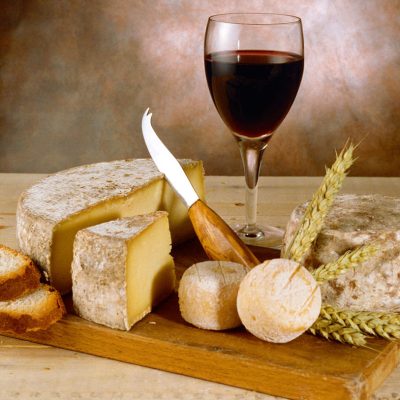
Excellent with grilled red meats, roasts, game, and braised meats, it also pairs well with semi-aged and aged cheeses, such as Castelmagno, Bra, and Piedmontese Toma.
Great with cured meats such as coppa, Asti salami, and pancetta.
Recipes to pair with Freisa d’Asti DOC


Freisa d’Asti DOC: Production
The production of Freisa is a careful and painstaking process that requires specific skills and a deep knowledge of the land.
Winemaking techniques vary from cellar to cellar, but the goal is always the same: to obtain a wine that best expresses the unique characteristics of this indigenous Piedmontese grape variety.
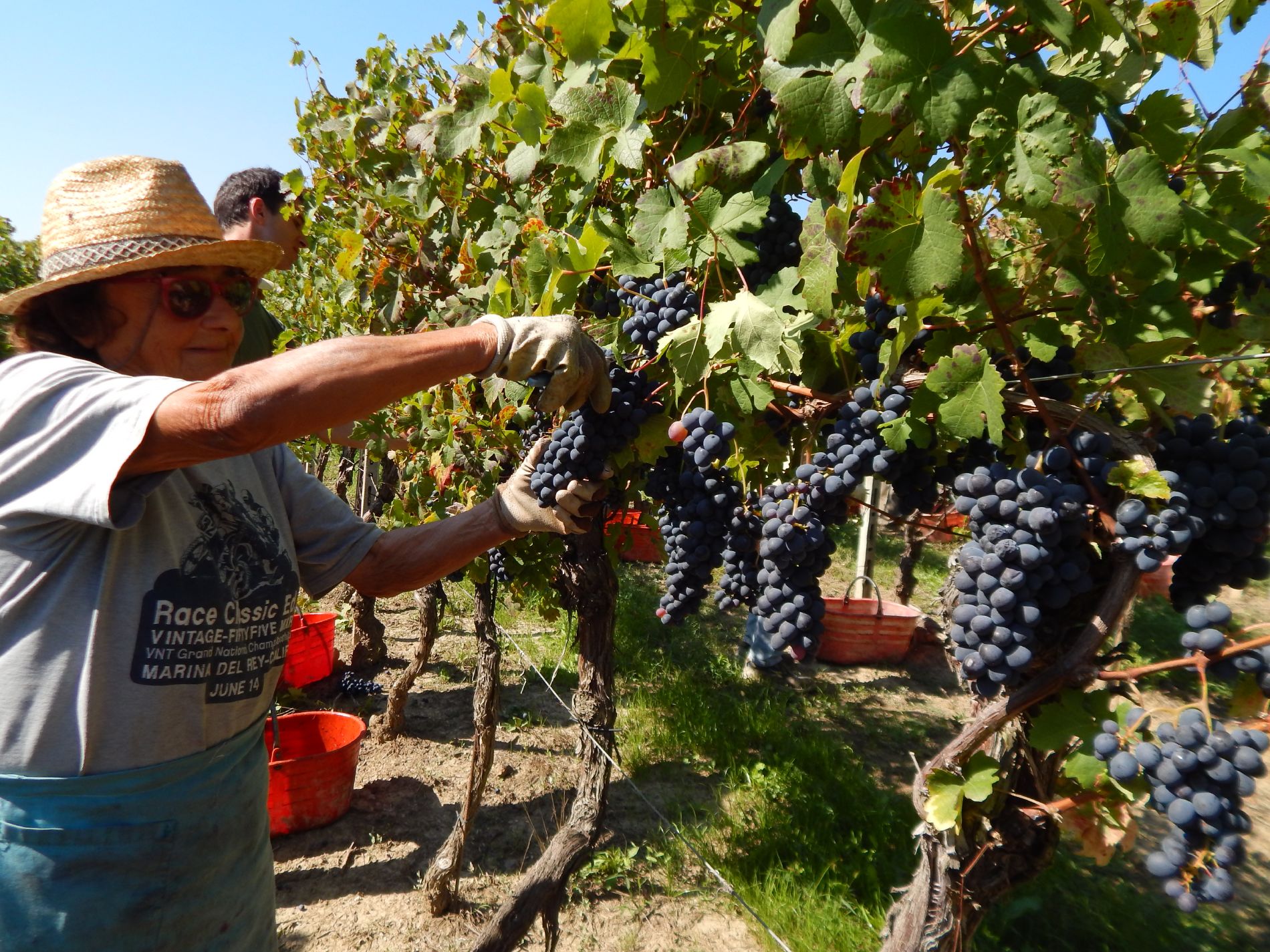
The harvest usually takes place in the second half of September. Choosing the ideal moment is fundamental to ensuring the correct ripening of the grapes and obtaining a balanced wine.
In the cellar, after destemming and crushing, the must is transferred to steel vats for alcoholic fermentation.
In this phase, the maceration of the skins is important, as they give the wine its typical raspberry note and ensure a more complex structure.
Young versions of Freisa d’Asti are bottled starting from the spring of the year following the harvest.
The Superiore version, on the other hand, must age for at least one year, of which a minimum of 6 months must be in wooden barrels.
Time in wood
Time in bottle
Time to market
Grapes Yield
Meet the producers


Curiosities
The fact that Freisa traditionally had a fruity note of strawberry/raspberry is also confirmed by the writer Hemingway in his novel A Farewell to Arms.
Having set out as a volunteer for the Red Cross during the Great War, he was wounded and treated at the Ospedale Maggiore in Milan.
Here, while convalescing, he had the opportunity to taste many Italian wines, including Freisa.
In a dialogue between the writer, the nurse he had fallen in love with (Catherine), and a waiter from Milan (one Giorgio), a funny discussion about Freisa begins.
Catherine and Hemingway insist on tasting Freisa, which apparently had a reputation as a strawberry-flavored wine.
The waiter denies that the wine actually tastes like strawberry and replies: “Imagine a country that makes a wine just because it tastes like strawberry.” At this point, Catherine replies: “It seems like a magnificent idea to me… Maybe it really will taste like strawberry, that would be beautiful.”
News about Freisa d’Asti DOC


