Barolo DOCG
The Barolo (d.o.c.g. D.P.R. 01/07/1980 – d.o.c. D.P.R. 23/04/1966) is a red wine with a controlled and guaranteed designation of origin produced in Piedmont, the spearhead not only of the region at the foot of the Alps, but of the entire peninsula.
It is the wine symbol of the Unification of Italy and is among the most appreciated and well-known Italian red wines in the world, thanks to the mysterious balance that gives it power and elegance at the same time, distinguishing itself as one of the wines with the greatest personality.
There are no different types of Barolo; the only distinction that is regulated, and which is good to know, is given by the minimum ageing and distinguishes Barolo into:
- Barolo DOCG with a minimum ageing of 38 months, of which at least 18 in oak barrels.
- Barolo DOCG riserva with a minimum ageing of 62 months, of which at least 18 in oak barrels.
A single prodigious grape variety
Barolo wines are produced from a single grape variety, Nebbiolo: its grape, despite having a great name, has a small home.
Only a few wine regions in northern Italy have a centuries-old history of producing prestigious wines derived from this grape variety.
Of course, Nebbiolo vines have been planted in other parts of the world, especially in recent times, but the authentic and highly appreciated character of the wines is a creation of the grape’s adaptation to its environment over the centuries, like a genetic memory, and it offers a certain resistance to being transplanted elsewhere, never generating a product with an elegance and complexity comparable to those of its own Italian soil.
But let’s discover in more detail the particularities and fascinations of this nectar, crowned by most as one of the most interesting and valuable wines.
Vines
Appellation
Color
Type
Min. alcohol
Variants
Established on
DOCG 1980

The history of Barolo DOCG
Origins that unfold from a marriage
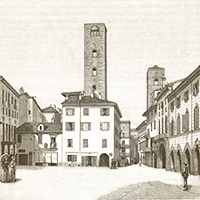
Among the first admirers of the nectar from Nebbiolo grapes were the Gauls and the Romans: the latter were so struck by the quality of the wine from the Alba area, then Alba Pompeia, that Julius Caesar, returning from the Gallic War, wanted to bring a large quantity back to Rome.
But for the Langhe Barolo wine, the first records date back to 1751, when a batch was sent to London.
It was such a great success that even the future President of the United States Thomas Jefferson mentions its goodness in his diaries, describing it as follows:
...almost as pleasant as Bordeaux and as brisk as Champagne...
A description that is very close to what we might say today about Lambrusco. The Barolo of those years was in fact a sweet and sparkling wine, and this was due to the fact that it was not yet known how to transform all the sugars contained in the must into alcohol.
The birth of Barolo as we know it today begins with a marriage, that of Carlo Tancredi Falletti di Barolo to Juliette Colbert. The Marchioness Colbert, thanks to the precious help of the great oenologist Louis Oudart, applied the techniques used for great French wines to all the wine produced on her estates in the Langhe.
Barolo vinified "in the French style" was a completely different wine compared to what had been known until then; it became a red, still, round, and structured wine that became so popular as to even intrigue King Carlo Alberto of Savoy.
It is said that one day, King Carlo Alberto asked the Marchioness why she had not yet let him taste the famous wine produced in the areas of the castle of Barolo. A few days later, Turin was the stage for an unprecedented spectacle: the city streets were crossed by 325 carts from Lady Colbert bound for the Royal Palace. Each of them contained a barrel of Barolo, one for every day of the year excluding the 40 days of Lent.
This was how Barolo arrived at the Savoy court and was defined as the wine of kings, the king of wines.

Barolo DOCG: Terroir
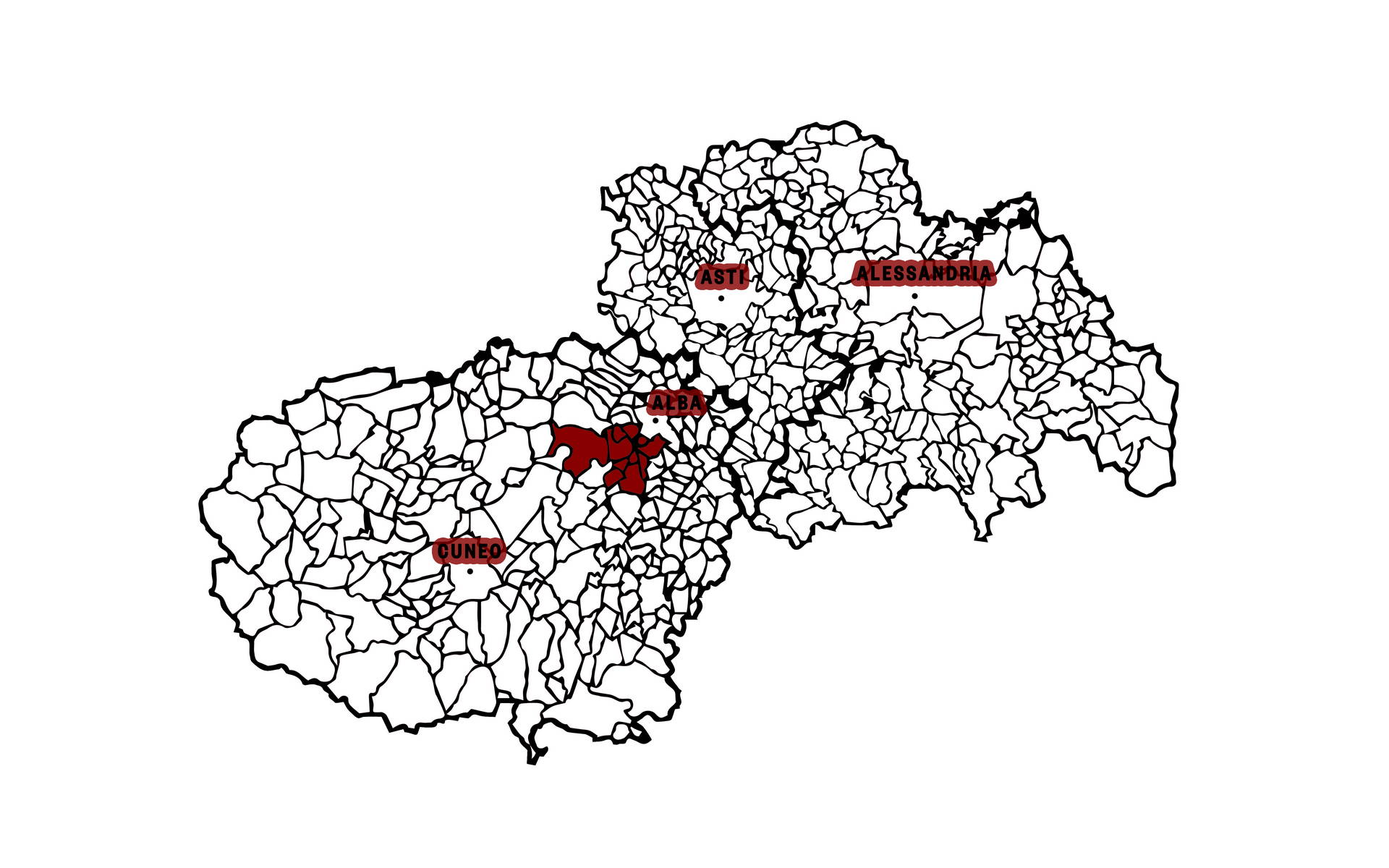
The 11 municipalities of Barolo
The Barolo production area is, as tradition and production regulations dictate, spread across 11 municipalities covering about 2,150 hectares of vineyards, and is characterized by hilly areas that offer a variety of distinct and drastic soils and styles, despite being only a few kilometers apart.
Of the included municipalities, some are included in their entirety (Barolo, Castiglione Falletto, and Serralunga d’Alba), and others only partially (La Morra, Monforte d’Alba, Roddi, Verduno, Cherasco, Diano d’Alba, Novello, and Grinzane Cavour).
Sands, Marls, and Sandstones: the role of geology in Barolo production
Between the end of the Langhian and the beginning of the Serravallian “Helvetian”, the soils of Serralunga d’Alba began to emerge, characterized by Lequio formations with layers of grey marl alternating with sandstones formed by more or less cemented siliceous sands; the presence of calcium carbonate and iron gives the soil grey-reddish tones.
Further west, in the middle of the Serravallian period, the territories of Monforte d’Alba and Castiglione Falletto emerged; the soil already has a different composition and alternates layers of more or less compact sand, grey-brown or yellowish in color, with grey sandstones (compacted sands cemented by carbonates from marine waters) called Diano Sandstones.
The area between Barolo and La Morra consists of grey-bluish marls, rich in magnesium and manganese carbonates, which on the surface turn a grey-whitish shade following the action of atmospheric agents; these are clays mixed with very fine sand, impregnated with a strong limestone component, which take the name of Sant’Agata Marls.
For this reason, Barolo takes on very different faces from one municipality to another.
The climate
The climate of this territory is temperate continental, thanks to the protection from the north, west, and south by the Alpine mountain range, and is optimal for wine production.
Generally, rainfall is concentrated in the months of April, May, and September, and this water supply can significantly influence the production of the vintage.
Fortunately, Nebbiolo is an extremely resistant plant, and therefore the rains do not affect the quality of the grapes, which still complete their ripening process during those days.
Preferred Altitude
Preferred Soil
Crus / MGA


Barolo DOCG: Vines
The Barolo DOCG is a single varietal wine, and therefore can be made exclusively by Nebbiolo grapes
Piedmont’s noblest red grape needs to grow in a carefully chosen environment and growing conditions. It sprouts early and the fruit generally ripens in mid October. The bunch is medium to large, a winged pyramid shape with medium to small grapes having a consistent blue-black skin with violet nuances. This is the vine that produces Barolo and Barbaresco, Nebbiolo d’Alba... you can read more about Nebbiolo here.

Barolo DOCG: Features
The synesthesia between the crown jewels
The Nebbiolos of Barolo are generally considered powerful and very tannic wines.
In reality, the true central element that makes them among the most critically acclaimed wines is the complex refinement with which these wines manage to express in the glass the character of this small Piedmontese town on top of the hill.
The best Barolos typically present balsamic elements and fresh florals, with notes of black liquorice, mint, and eucalyptus.
All in harmony with the earthy, austere, and tarry characteristics that remind us of the soil and the territory of origin, and which are some of the main factors of attraction for traditionalist producers and consumers.
The weightless power and aromatic complexity and the aromatic complexity found in some of the most traditional and aged Barolos can only be compared to similar qualities found in the great Pinot Noirs of Burgundy.
Sight
Barolo presents a transparent ruby colour, which turns towards orange with ageing.
In this, wines from Nebbiolo have colorations that, in terms of transparency, approach those of the best Pinot Noir with violet nuances.
One must not, however, be misled by the lightness of the coloration; Barolo is in fact a wine of great consistency.
Nose
The bouquet, intense, evolves from hints of violet and dried dog rose to "goudron", fading into an ethereal, very peculiar bouquet full of small red fruits like raspberries and blackcurrants, cherries in spirit, lacquer, leather, green pepper, anise, nutmeg, and liquorice.
But what makes it unmistakable are the scents of the Langhe such as hazelnut and truffle.
Taste
From a complex bouquet rich in red fruits and spices, the flavour provides harmonious sensations of fullness and austerity, pleasantly persistent.
On the palate, it is in fact elegant and measured, not particularly acidic, but rather earthy, with tannins that give structure to a fruit that intertwines with delicious notes of liquorice and coffee.
Official regulation
Color
Perfume
Taste
Foam
Get a bottle directly from the producer
LoveLanghe Shop is a niche of great wines from the Langhe area: some unknown to most, some already quite recognized but perhaps hard to find in the big distribution, others in which we see potential but that have yet to grow.
Bottles are shipped directly from the winery to your home, with no intermediary.


Service
Barolo wine should be served at a temperature of 18-20°C.
The best glass for tasting is a very large goblet, with a wide aromatic chamber, suitable for fully developing the complexity of this wine.
A glass with a particular angle such as to direct the wine to the part of the mouth most sensitive to sweetness, in order to fully capture the richness, maturity, and integrity of the flavors.
Barolo should not be drunk young; it is a wine capable of improving in the cellar up to ten years after the harvest.
Barolo DOCG: what to pair it with
Richness for richness, it is recommended to accompany the full-bodied Barolo wine with earthy first courses such as a good mushroom risotto or with meat sauce, red meats, boiled meats, braised meats, and roast chicken.
It expresses its personality even better if accompanied by game or a dish based on truffles as well as all aged hard cheeses.
Perhaps not a meal that could be defined as "light," but man does not live by lightness alone; your taste buds will make bells and great bells ring in your palate.
Recipes to pair with Barolo DOCG


Barolo DOCG: Production
After the harvest and crushing, the fermentation of Nebbiolo grapes consists of two steps.
The first is the alcoholic one, which occurs spontaneously, leaving the skins and seeds to macerate in the must. This phase can last from 10 to 30 days, and is characterized by pumping over: manual or mechanical breaking of the cap of skins that tends to form on the surface.
A fundamental factor of alcoholic fermentation is the temperature, considered excessive above 35 degrees Celsius because it can lead to the activation of acetic bacteria that transform sugar, no longer into alcohol, but into acetaldehyde and subsequently into acetic acid.
The malolactic fermentation of Barolo DOCG
The phase following this first cycle is the second fermentation: malolactic fermentation. It consists of the transformation of malic acid into lactic acid; it can be activated immediately after alcoholic fermentation or scheduled directly for the following spring, when it will occur spontaneously with the increase in temperatures as the summer months approach.
The ageing of Barolo
Once both fermentations are finished, Barolo is ready to begin the most important period of its life, the one that will lead it from a young wine to evolve and become an adult wine: ageing.
There are quite a few schools of thought that characterize this evolutionary phase of the wine; some producers prefer the use of large wooden barrels for ageing while others entrust the maturation of their product to barriques: small barrels.
The barrels
The wine is aged in wooden barrels because it is thanks to the use of this element that tannins soften, and the color is durably stabilized, protecting the wine itself from natural degradation.
Large wooden barrels allow for very slow gas exchanges and produce wines with warm and intense colors that need more time to be fully mature, while small barrels allow for much more intense gas exchanges and produce wines with a younger and fresher color that stabilize faster.
The wood used is always oak, but from different origins depending on the result to be obtained: French oak is chosen to obtain soft and elegant wines, Slavonian oak for more aromatic wines, and finally American oak to develop more structured wines.
In any case, to obtain a Barolo that aspires to perfection, it is appropriate to carry out a further refinement in the bottle for at least 12 months.
Time in wood
Time in bottle
Time to market
Grapes Yield
Meet the producers





Curiosities
One of the most expensive collector's Barolos in the world
Among the most expensive Italian wines ever is the Barolo DOCG Bruno Giacosa Collina Rionda: a Langa wine at the top of the world rankings, which even beats the French in Asian auctions.
Barolo Collina Rionda comes from Bruno Giacosa’s winery “Le Rocche del Falletto” in Serralunga d’Alba.
He himself describes it like this on his website
Garnet red color. Broad, complex, elegant bouquet reminiscent of rose, ripe fruit, truffle, and spices. The flavor is dry, full, generous, harmonic, and velvety. A wine of aristocratic texture
A very rare collector’s wine due to the fact that Bruno Giacosa’s winery no longer bottles it from its site of origin, which makes it a purely collector’s item for those who love Barolo, as well as a true treasure, especially if one possesses bottles from the best vintages.


