
The Truffle
Product Type
Production Area
First mention
Quality mark
Obtained on
The truffle is one of those ingredients that make themselves known right away: just a few shavings grated over a warm dish are enough for its aroma to take center stage.
When we think of truffles, our minds almost immediately go to the Prized White Truffle, commonly known as the White Truffle of Alba, its most prized variety and one of the best-known products of Piedmontese cuisine.
Before reaching our tables, though, the truffle leads a far less showy life: it is in fact an underground fungus, belonging to the genus Tuber, that grows below the surface of the soil.
It has neither roots nor leaves, and to develop it needs a plant belonging to a limited list of tree species, with which it lives in symbiosis. Through its long mycorrhizae, the fungus and the plant maintain a mutual exchange of “services”: the truffle receives nutrients from the roots, while helping the plant absorb water and mineral salts from the deeper layers of the soil.
What is harvested is its fruiting body: on the outside it is protected by the peridium, while inside lies the gleba, a flesh crossed by veins that are more or less visible depending on the species and degree of ripeness.
Shape, color, aroma and harvest period can vary greatly: alongside the white truffle, there are also summer and winter black truffles, bianchetto truffles and other varieties, each with its own distinct characteristics and different culinary uses.
Their growth and ripening depend on a delicate balance of soil, humidity, climate and symbiotic plants. To find them, however, what’s needed is a dog’s keen sense of smell and the knowledge of the truffle hunter: two elements that remain essential today for a harvest that takes place almost entirely out of sight.
Name origin
The etymology has long been debated.
The traditional theory traces it back to the Latin terrae tuber ("tuber of the earth"), later evolving into vernacular forms such as territùfru and terrae tufer (a late-Latin variant of tuber).
A more recent interpretation, proposed by historian Giordano Berti, instead links the name to terra tufide/tufule tubera, a phrase attested in the Tacuinum sanitatis (14th century): the reference would be to the resemblance of this underground fungus to tufa, the porous stone typical of central Italy.
From here come the popular contractions (tartùfola, trìfula, tréffla, trìfola).

Tartufo In the kitchen
Few ingredients, to let the aroma shine
The truffle doesn’t need elaborate preparations; in fact, it’s the simplest dishes that show it off best: fried eggs, tajarin with butter, risottos, fonduta, and in general recipes where a few ingredients leave room for its aroma.
The Prized White Truffle is best raw, sliced into thin shavings right onto the dish. The warmth of the food helps release its aroma, while actual cooking would risk altering it.
With black truffles, however, the possibilities change. The Prized Black Truffle also lends itself to gentle cooking and can enrich sauces, creams and butter-based dressings. The Scorzone, with its milder character, pairs well with potatoes, polenta, eggs and fresh cheeses, as well as warm grain salads.
The Uncinato goes well with pasta and risottos with simple dressings, while the Bianchetto, with its sharper aroma, can be paired with vegetables such as asparagus and artichokes, or used in delicately flavored dishes, including fish-based ones.
The choice therefore depends on the variety, but also on the result you want to achieve: not all truffles are used in the same way, and the most prized one isn’t necessarily the one recommended for the recipe you want to make.
Cleaning and storage
The truffle is a fresh and delicate food, which tends to gradually lose aroma and texture. For this reason, it’s best to eat it shortly after purchase.
Most of the soil on the surface should be removed with a soft brush, with final cleaning done just before eating (rinse it under water and give it another brush before eating).
If you need to store it for a few days, you can wrap each truffle in a cotton cloth or paper towel, changed regularly, and place it in a sealed glass container in the fridge.
Black truffles are also better suited to freezing. The white truffle, on the other hand, is particularly sensitive to losing its aromatic compounds and should therefore be eaten fresh.
The only way to store white truffle long-term while limiting the loss of flavor and aroma is to cut a few shavings into a small jar of honey: this will give you a wonderfully fragrant sauce to pair with cheeses.
Tartufo: nutrition facts
The truffle is mostly made up of water and fiber, along with varying amounts of protein, fat and carbohydrates. It also contains minerals, including potassium, phosphorus, calcium, magnesium, iron and zinc, as well as B vitamins.
From a nutritional standpoint, however, what really matters is the quantity actually consumed: the few shavings that typically top a dish have a limited impact on the overall diet.
Its value in the kitchen lies mainly in its aroma and aromatic qualities, rather than its nutritional content, so it's these qualities that are worth focusing on when choosing and using it.
Energy for 100 g
Proteins for 100 g
Carbs for 100 g
Sugar for 100 g
Fats
Fiber
Average weight
Related recipes


Organoleptic characteristics
Aroma is the truffle's most recognizable trait, but also the one that varies most from one species to another. It can be intense and pungent, delicate and mushroomy, or recall garlic, hay, damp earth, honey and dried fruit.
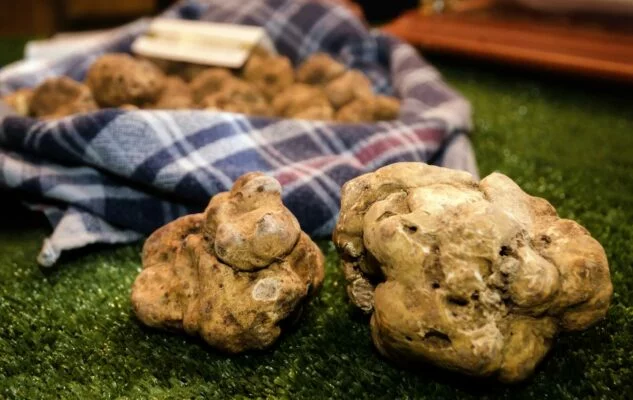
Appearance also helps distinguish between varieties. The peridium, that is, the outer surface, can be smooth or covered in warts of varying prominence, with colors ranging from pale yellow to nearly black brown.
Inside, the gleba shows different shades and veining. Its coloring changes not only according to the species, but also with ripening.
A ripe truffle develops the aromatic profile characteristic of its variety. That's why aroma, texture and internal appearance are important factors for assessing its condition, as well as for identifying it.


Tartufo
A story that
begins in
The truffle has fascinated people for thousands of years. It was already known and eaten in ancient times, although it is not always possible to establish which species the texts of the period were referring to.
Between ancient legends and banquets
Among the Sumerians there is evidence of underground fungi being used in cooking, while in ancient Greece the truffle also appears in gastronomic tales and anecdotes. One of the best known concerns the cook Cherippus, whose recipe was said to have been so appreciated by the Athenians that his sons were granted citizenship.
The Romans also knew about it. It is mentioned by Pliny the Elder in his Naturalis Historia, as well as in gastronomic accounts linked to Apicius.
Its hidden growth gave rise to many fanciful explanations. According to a legend recounted by Juvenal, the truffle was said to have been born from a thunderbolt hurled by Jupiter near an oak tree. This divine origin also contributed to its reputation as an aphrodisiac.
It's worth remembering, however, that many of the truffles described by ancient authors may have belonged to the genus Terfezia, different from the species of the genus Tuber most sought after today.
From the Renaissance to the European courts
In the Middle Ages, gastronomic references become rarer. The truffle then returns to the table more frequently during the Renaissance, including in courtly settings, where it is associated with banquets and refined dishes.
In 1564, physician Alfonso Ciccarelli dedicated a treatise to it, while the studies of naturalists gradually began to clarify its true nature.
Between the 17th and 18th centuries, in Piedmont, the truffle took on an important role in court life as well. Searching the woods became an activity to show off to distinguished guests, part gastronomic curiosity, part aristocratic custom.
When the truffle becomes a subject of study
With advances in scientific knowledge came the first modern classifications.
In 1788, Piedmontese physician Vittorio Pico described the white truffle under the name Tuber magnatum, while in 1831 naturalist Carlo Vittadini published the Monographia Tuberacearum, a landmark work for the study of truffles, describing numerous species.
Since then, scientific research has deepened our understanding of the relationship between these fungi, plants and the environment in which they grow.
The truffle today
Today the truffle holds an important place in the gastronomy and culture of several Italian regions.
In Alba, the International White Truffle Fair has become one of the best-known events dedicated to the product, drawing visitors, enthusiasts and industry professionals every year.
In 2021, the search and extraction of truffles in Italy was recognized by UNESCO as an Intangible Cultural Heritage of Humanity: a recognition that concerns the traditional knowledge and practices of truffle hunters, not the truffle as a food product.
Farming
Can truffles be cultivated?
The truffle grows spontaneously in the wild, but some species can also be produced by establishing cultivated truffle grounds.
It is not sown or planted directly in the soil like a vegetable; instead, mycorrhized plants are set out, meaning young trees whose roots have already been associated with the fungus, in an effort to recreate the conditions it needs to develop.
The presence of the plant, however, is not enough. Specific conditions of soil, climate, moisture and exposure are required, which vary according to the species.
In general, many truffles prefer calcareous soils, but needs can differ greatly. The Prized White Truffle, for example, requires cool environments and soils able to retain a certain amount of moisture without becoming waterlogged. The Prized Black Truffle, on the other hand, prefers well-drained soils, often stonier and more sun-exposed.
Among the plants that can form a symbiosis with truffles are oaks, hazels, poplars, willows, lindens and hornbeams, with different associations depending on the variety.
Three types of truffle ground
Three main situations can generally be distinguished.
Natural truffle ground: the truffle grows spontaneously, without the area having been established through planting.
Controlled or managed truffle ground: an already productive environment is tended with measures aimed at preserving or improving its conditions.
Cultivated truffle ground: created through planting on land considered suitable, using mycorrhized plants from specialized nurseries.
Not all species respond the same way to these techniques. Cultivation of the Prized Black Truffle and the Scorzone is more established, while obtaining the Prized White Truffle through cultivated plantings remains more complex, and even impossible according to some experts.
Even under favorable conditions, the timing and quantity of the harvest are not guaranteed: the truffle’s development depends on numerous climatic factors and can vary dramatically from one year to the next.
Harvest time
Preferred Soil
Plants per hectare
Harvest per hectare

Foraging
The trifulau and his tabui
Here in the Langhe, the truffle hunter is called a trifulau, or trifolao: an expert in the local landscape, who knows the woods hidden in the most overgrown riverbanks, and the locations of the right plants.
Working alongside him is the truffle dog, traditionally called the tabui: thanks to its sense of smell, it locates the spot where the truffle has ripened and signals it to the hunter.
At that point, the trifulau’s skill comes into play: using a small tool, the vanghetto, he carefully clears away the soil and extracts the fungus without damaging it. It is essential to pull the dog away in time, before it breaks the truffle while digging (or eats it, if it’s particularly fond of food).
The hole is then filled back in, replacing the soil that was removed: an essential gesture to bring the fungus’s spores back down into the ground and give it the chance to grow again the following year.
Knowledge passed down from generation to generation
The search requires observation, patience and familiarity with the natural environment. The trifulau learns to recognize symbiont plants, to read the progression of the seasons and to identify the most favorable areas.
Traditionally, many hunters prefer to go out at night, when there is greater quiet and privacy. This isn’t an absolute rule, though: the search can also take place at other times of day, in compliance with current regulations.
The best spots are often kept discreetly guarded. Routes, finds and signs on the ground are part of a body of knowledge built up over time, also through the relationship with those who practiced the search before.
Harvesting is regulated, and each species has its own calendar, set at the regional level. In Piedmont, moreover, specific requirements and authorizations are needed to carry out this activity, as established by law.
Foraging time
Preferred Soil

Pier Carlo Vacchina and his beloved tabui will make you live a unique experience.
Varieties
White or black, inexpensive or costly?
White or black? That's the most obvious distinction, but the world of truffles is far more varied. The aroma, color, texture and even the time of year they arrive on our tables all change.
Some stand out for their intense aroma, others have a more delicate character. And the most expensive truffle isn't always the right one for the dish you have in mind.
-
Tuber magnatum Pico
Prized White Truffle
Despite its name, it isn't always white. The surface, smooth and often irregular, can range from pale straw yellow to ochre, with a hint of greenish tones. Inside, the flesh is pale, crossed by thin veins.
But it's above all the intense aroma that makes it so sought after: a combination of notes that can recall garlic, hay, damp earth, honey and spices.
It is mainly harvested in autumn and early winter, and in the kitchen it prefers simplicity. No cooking required: a few fresh shavings over a warm dish are enough.
-
Tuber melanosporum Vittad
Prized Black Truffle
Dark outside, dark inside, the Prized Black Truffle is also known as the Black Truffle of Norcia or Spoleto.
The surface is covered in small warts, while the flesh, dark brownish-black in color, shows thin pale veins. Its aroma recalls the forest floor, and its taste has notes reminiscent of mushrooms, hazelnuts and chestnuts.
It is a typically winter truffle and, unlike the white truffle, doesn't mind gentle cooking. In fact, it can be at its best in sauces and dressings, where its aroma has room to develop.
-
Tuber aestivum Vittad
Scorzone, or Summer Black Truffle
The name Scorzone already says something about its appearance: the surface is dark, rough and covered in rather large warts.
Cutting into it reveals a much paler flesh, which takes on hazelnut tones as it ripens and is crossed by clearly visible white veins.
Compared to the Prized Black Truffle, it has a more delicate aroma, with notes reminiscent of mushrooms. It is also a fairly common species, capable of adapting to different environments.
As its other name suggests, it's mainly harvested in summer, although the Piedmontese calendar also includes a further autumn period. In the kitchen it's versatile: it can be used fresh or added to cooked dishes.
-
Tuber uncinatum Chatin
Uncinato Truffle
At first glance it could be mistaken for the Scorzone, its close relative. The Uncinato also has a dark, warty surface, but inside the flesh tends toward more intense colors, from hazelnut to chocolate brown.
The most interesting difference, however, lies in the aroma: stronger than that of the Scorzone, as is the taste.
It is an autumn truffle, well suited to simple pasta, risottos and dressings, where its aroma can come through without being overpowered by other ingredients.
-
Tuber borchii Vittad
Bianchetto, or Marzuolo
Small, pale, and with an aroma that doesn't go unnoticed. The Bianchetto, also known as the Marzuolo, may look similar to the Prized White Truffle, but it has a personality all its own.
The surface is smooth, with shades ranging from whitish to ochre and brown, sometimes with reddish tones. Inside, the flesh moves from pale, pinkish colors to darker shades as it ripens.
Its most distinctive trait is its pungent aroma, distinctly garlicky, which sets it apart from other pale truffles.
It's harvested between winter and spring and can be used either fresh or to add character to flavored butter, sauces and other dressings.