Royal Castle of Govone
Business Hours
10:00 AM → 12:30 PM
3:00 PM → 6:00 PM
Closing Day
Tuesday
Wednesday
Thursday
Holidays
Floors
Languages
Tickets
Interiors: €6.00
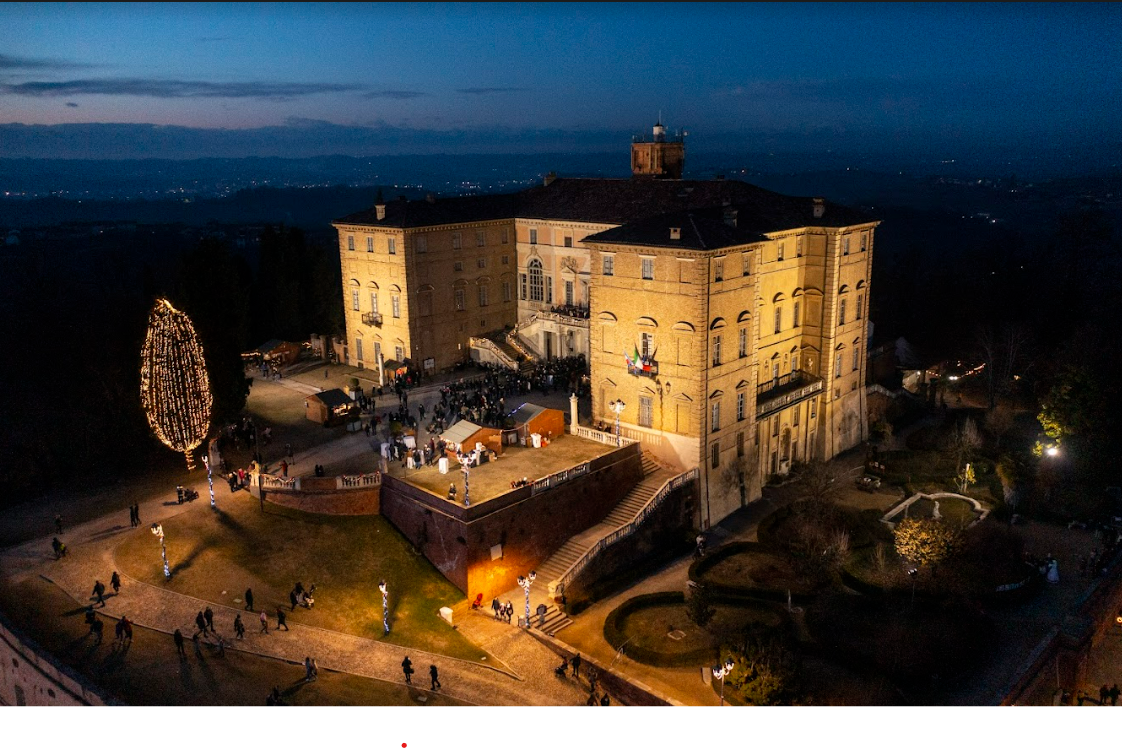
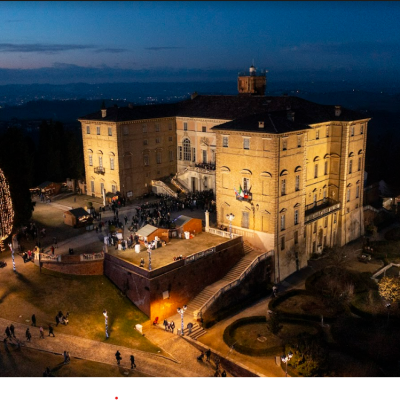
The Castle of Govone dominates the town with its imposing Baroque facade and tells centuries of transformations, noble ambitions, and Savoy summer stays. The visit passes through richly decorated rooms, panoramic terraces, and gardens overlooking the Roero and the Alpine arc.
It was the Solaro counts who transformed the ancient defensive building into an elegant residence. The first project was entrusted to Guarino Guarini and was subsequently taken up by Benedetto Alfieri. Among the castle’s distinguished guests is also Jean-Jacques Rousseau, who stayed here in 1730 while in the service of Count Ottavio Solaro.
At the end of the 18th century, the residence attracted the attention of the Savoys. Vittorio Amedeo III purchased it in 1792, and the castle subsequently became one of the summer residences of the royal family. It was Carlo Felice, however, in the early decades of the 19th century, who gave it its most solemn appearance, enriching the apartments and having the great Hall of Honor decorated.
Today the tour leads through 18th-century stucco, theatrical frescoes, and the surprising Chinese Rooms, covered with rare oriental wallpapers. Since 2007, the Castle of Govone has been part of the UNESCO site of the Residences of the Royal House of Savoy in Piedmont and is one of the most original places to discover among the hills of the Roero.

TheHistory
Royal Castle of Govone
Since Roman times, a "fundus" was located in the area of Cadeliano, and another perhaps in "Mayrano."
The fortunately elevated position of the Castle of Govone has always attracted the presence of a noble residence or even a fortress, which was indeed already erected in the Middle Ages.
The original fortress was still partially visible when, around the end of the 17th century, the Solaro counts decided for the first time to undertake renovations, consulting on the occasion even the great architect Guarino Guarini.
That first ambitious project was never completed, and it was necessary to wait for the initiative of Antonio Maurizio Solaro (1689-1762), Marquis of Breglio and Grand Prior of the Order of Malta in Lombardy, for work to begin.
Antonio Maurizio is primarily responsible for the construction of the east wing, the decorations of the ground floor, and those of the so-called Montesquieu Apartment. Thanks to the preservation of many documents from the period and even personal correspondence of the Grand Prior, we know the zeal and attention that Antonio Maurizio devoted to this first phase of construction. During this period, the west wing remained medieval in form and structure, destined to disappear in subsequent decades with work on the piano nobile and further expansions, carried out first by the Solaro family and later by the Savoy family with Carlo Felice.
At the end of the 18th century, the Castle of Govone officially passed into Savoy hands, and a few years later it was chosen as a summer residence by the royal family. The Savoys already knew its healthy and pleasant air, having been guests there in the 1780s on the occasion of their inoculation against smallpox. On that very occasion, the Solaro counts had to accelerate the work begun by Antonio Maurizio to make the castle suitable for hosting the Savoy royals. The Grand Staircase dates from this phase, which the royal family used to reach the apartments on the piano nobile.
It was Carlo Felice who made the castle a royal residence in every respect through various expansions and, above all, the majestic decoration of the Hall of Honor, with the cycle depicting the legend of Niobe. The most notable and important use of the piano nobile also dates from the time of Carlo Felice, when it was occupied by two daughters of Vittorio Emanuele I and the future wife of Carlo Alberto. The three princesses resided in what are now known as the Princesses' Apartment or Chinese Rooms, due to the presence of highly distinctive oriental wallpaper.
With the Savoy family's move to other destinations after the Unification of Italy, the castle was transferred to the Municipality of Govone in 1897. Since then, it has been used by the community as a school, administrative center, and today as town hall and public library. Since 2007, the Castle of Govone has been a UNESCO World Heritage Site as part of the Residences of the Royal House of Savoy. It is also part of the "Castelli Aperti" (Open Castles) circuit and can be visited on the piano nobile, part of the ground floor, and in the garden.
The Interior
Rich decorations blending oriental taste, stucco, and precious frescoes
The interiors of the Castle of Govone testify to its different phases of construction and occupation.
The ground floor, the first to be built at the behest of Antonio Maurizio Solaro, is in purely 18th-century taste. Stucco and extremely fine decorations in soft colors take center stage, and the cross of the Order of Malta above the doors recalls that the first to live there was the Grand Prior himself.
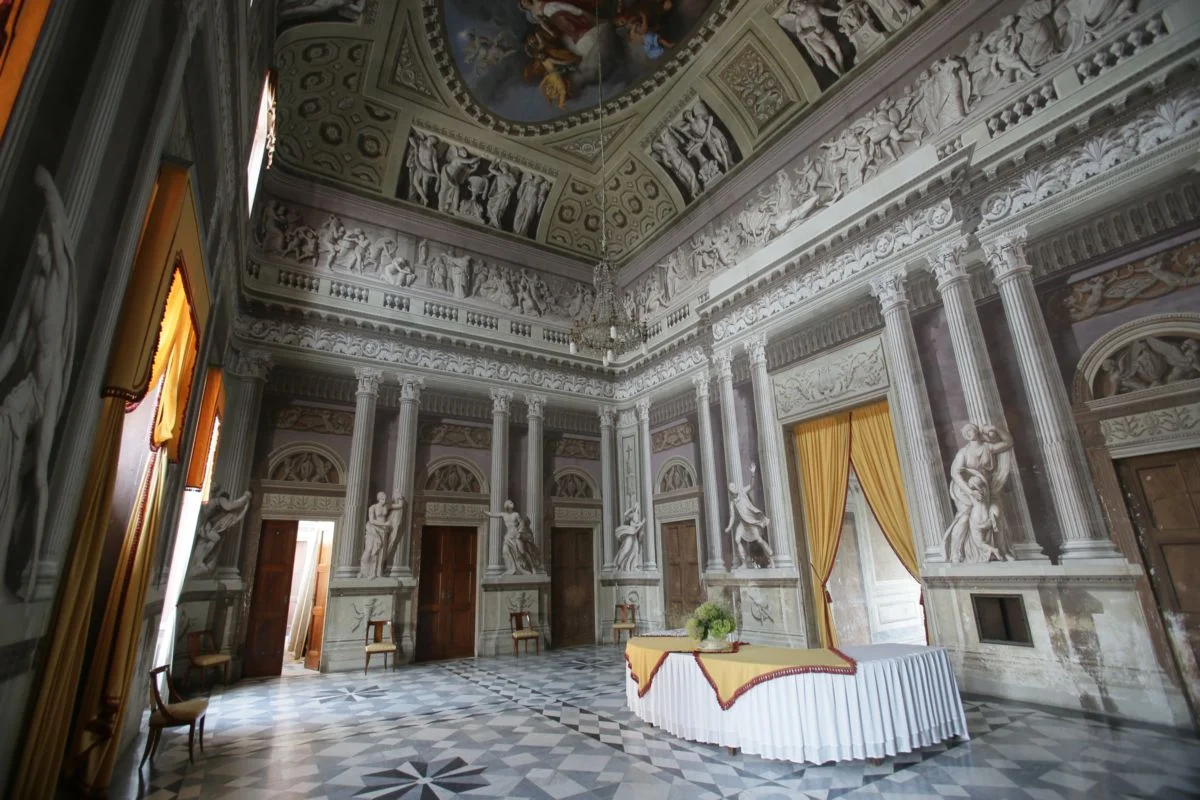
Ascending to the piano nobile, the impression is of having changed eras. And here, in fact, most of the decorations date back to Carlo Felice (1765-1831), including those of the unmissable Hall of Honor, frescoed between 1819 and 1821 by Luigi Vacca and Fabrizio Sevesi on commission from the sovereign.
Carlo Felice had personally chosen the tragic legend of Niobe, punished by the gods for her hubris and forced to witness the killing of her twelve children.
The Hall of Honor is designed to resemble a theatrical set, and is polychrome only in the central part of the vault. The other walls imitate marble to create a trompe-l’œil architectural effect.
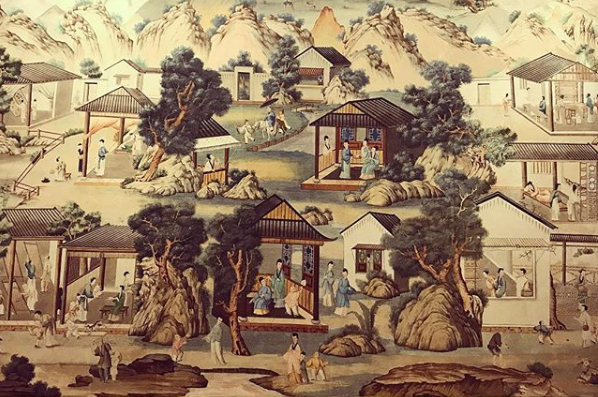
Also on the piano nobile, you can visit the Chinese Rooms or Princesses’ Apartment. These three rooms are entirely decorated with precious wallpaper from China, depicting trades and floral and animal motifs.
Not to miss
Visit Duration
Audioguides
Guided Visit
Style
Il Castello è parte del circuito delle Residenze Reali Sabaude, patrimonio Unesco dal 1997.
The Exterior
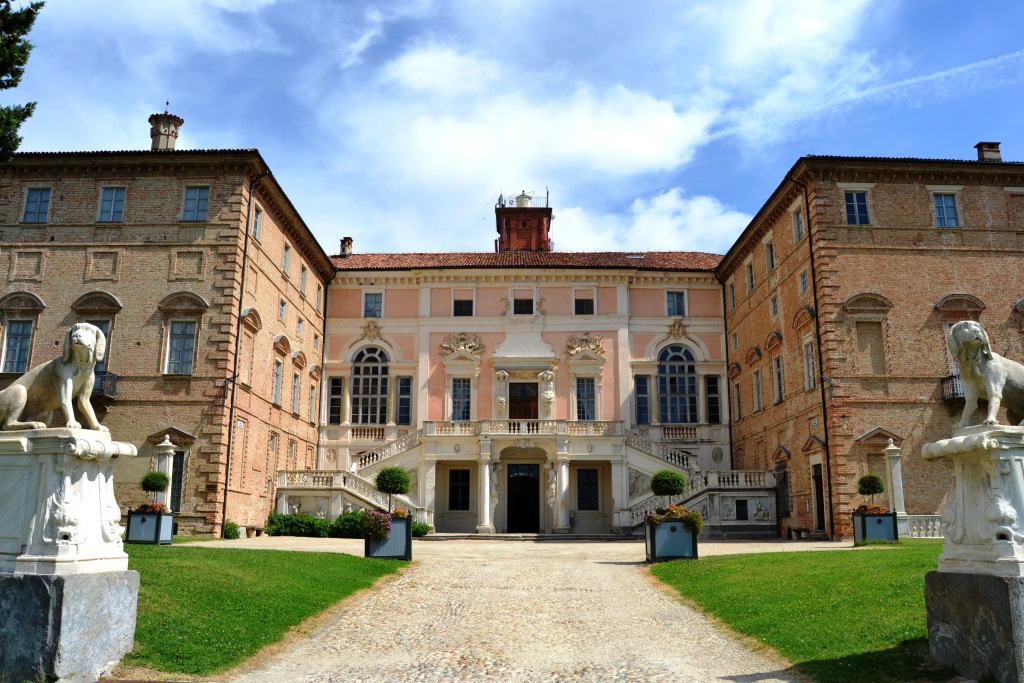
A monumental staircase, terraces overlooking the Roero, and a view reaching to the Alps.
The Grand Staircase
Welcoming visitors from outside is the imposing facade with the Grand Staircase, commissioned by the Solaro family around 1783, on the occasion of a brief stay by Vittorio Amedeo III and his family in Govone.
Most of its elements come from the Palace of Venaria and from the Fountain of Hercules that once adorned it and was then dismantled at the beginning of the 18th century. Its materials were reused by the Solaro family for their castle, which at the time needed to elevate itself to a rank sufficient to host the sovereigns.
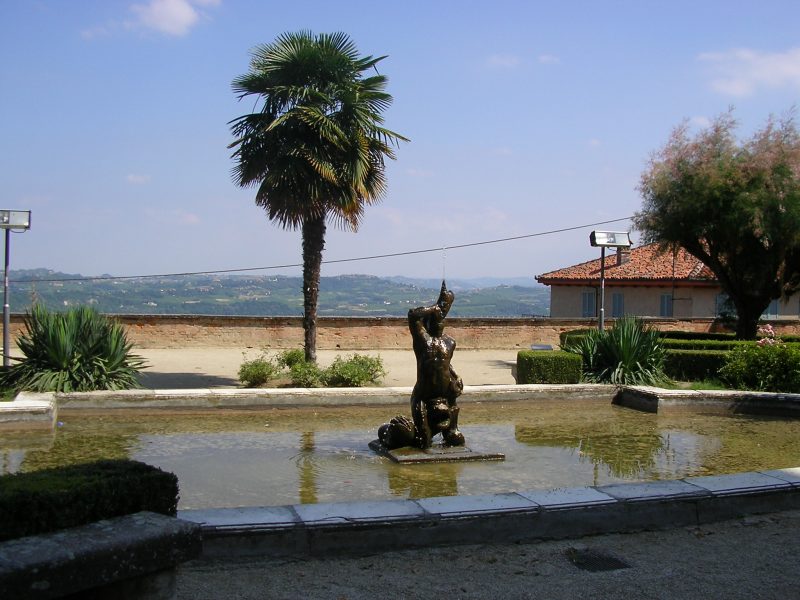
With your back to the Staircase, you can enjoy the view over the Langhe, the Roero, and the Alpine arc directly from the large panoramic terraces.
Park and Gardens
The outdoor spaces, the park, and the Italian-style gardens of the castle were progressively expanded between the 18th and 19th centuries. An initial core developed around the east wing of the castle, the oldest, and then expanded well beyond the original perimeter. The entire complex became property of the Municipality of Govone in 1897, which opened it to the public.
After being used as a playground and recreation area, today it is meticulously maintained and constitutes an elegant space, freely accessible to visitors and citizens.
The Park of Remembrance, originally known as Parterre di Ponente, is located on the west side of the castle.
In 1922, by order of the Ministry of Education, Italian municipalities were required to dedicate a portion of their territory to the memory of those who fell in the Great War. Govone chose this space, which already belonged to the Savoy residence.
For the occasion, 85 cypress trees were planted, in memory of the 85 fallen from Govone, and several monuments were erected in their memory.
Visit Duration
Audioguides
Guided Visit
Style
The Chinese Rooms
Unique in Piedmont and a rarity in Europe
On the piano nobile of the Castle of Govone are the so-called Chinese Rooms, a group of three rooms known for having hosted three royal princesses and consisting of an audience hall, bedroom, and cabinet (boudoir).
These rooms are entirely decorated with wallpaper made of plant fibers of Chinese manufacture, purchased by the Solaro counts in the first half of the 18th century in Vienna, but probably originating from London, the main port and market for goods arriving from China. The 18th century saw tremendous interest on the part of noble elites in the Far East, with widespread circulation of imported goods in European residences. The Solaro choice is therefore not surprising.
What makes the wallpapers of Govone unique is not their origin, but what they represent.
While it was not at all rare to find rooms decorated in oriental style, they were united by the presence of floral and animal motifs, such as those visible in the castle’s boudoir.
Much more unusual, almost unique, was the depiction of trades and production present in the other two rooms: tea production and silk for the audience hall, and rice and porcelain for the bedroom. Small scenes of daily life, populated by dozens of miniature figures, inhabit the castle spaces, offering visitors a vision unique in Piedmont and extremely rare in Europe (fewer than a dozen similar representations are found today across the entire continent).
The reason for this choice by the Solaro family remains partly a mystery, but can perhaps be explained by the commercial interests of the territory: silk, rice, and to a lesser extent porcelain were (and still are) among the best-known products of Piedmont, and therefore their presence on Chinese wallpaper may have attracted the Solaro family’s attention at the time of purchase.
The depicted scenes
Carte da parati cinesi
Eat & Drink in Roero




Royal Castle
of Govone
in Govone
Royal Castle
of Govone
in Govone
Royal Castle of Govone
Business Hours
10:00 AM → 12:30 PM
3:00 PM → 6:00 PM
Closing Day
Tuesday
Wednesday
Thursday
Holidays
Floors
Languages
Tickets
Interiors: €6.00
Are you planning a trip in the Langhe region?
Let us help you design the perfect vacation, and live your stay like a true insider
Free
Service
Ask us
For advice
Free Service
Ask us
For advice
Free Service
Fill in the form
reporting your interests and preferences
Receive our suggestions
directly into your inbox
And if it's not enough
we'll design a personalized trip!